
The global construction landscape is witnessing a significant shift toward composite materials that can withstand extreme environmental stressors without compromising aesthetic appeal. At the forefront of this movement is WPC Wall Cladding, a material engineered to solve the most persistent issues in exterior design: thermal expansion and moisture-induced decay.
For architects and contractors, selecting the right exterior wall cladding is no longer just about the initial visual impact. It is a calculated decision based on life-cycle costs, maintenance requirements, and structural reliability. In regions with fluctuating temperatures or high humidity, traditional wood often fails within five to seven years. In contrast, modern wood-plastic composites offer a lifespan that often exceeds two decades.
Table of Contents
Engineering for Thermal Stability: Heat Resistance in Focus
One of the most frequent questions from developers involves the heat resistance test of WPC wall cladding in tropical climates. Standard polymers often soften or warp when exposed to direct, sustained sunlight. However, high-grade WPC Wall Cladding is manufactured with specialized UV stabilizers and high-density polyethylene (HDPE) that maintain structural integrity even when surface temperatures exceed 60°C.
Thermal expansion is a physical reality for any building material. Traditional wood expands unevenly based on grain direction, leading to cracks. WPC, however, has a predictable linear expansion coefficient. According to ASTM D696, which measures the Coefficient of Linear Thermal Expansion of Plastics, engineered composites can be precisely calculated during the installation phase to leave “expansion gaps.” This prevents the “buckling” effect common in inferior heat resistant wall cladding products.
Waterproofing and Moisture Management
In high-humidity environments, moisture is the primary enemy of structural facades. Traditional timber is porous; it absorbs water, which leads to rot, mold, and termite infestations. WPC Wall Cladding utilizes a closed-cell structure. During the extrusion process, the wood fibers are completely encapsulated by the polymer matrix, rendering the panel hydrophobic.
This waterproof nature makes it one of the best waterproof interior wall panels for commercial restrooms and exterior facades in coastal areas. Because the material does not absorb water, it does not swell. This dimensional stability ensures that the tongue-and-groove locking systems remain tight and secure for the duration of the building’s life.
Comparing Performance: WPC vs. Traditional Materials
To understand the long-term value, we must look at the technical specifications that drive procurement decisions. When performing a composite siding vs fiber cement: a long-term ROI analysis, WPC often emerges as the winner due to its lighter weight and faster installation times.
Technical Performance Matrix
| Feature | WPC Wall Cladding | Natural Hardwood | Fiber Cement |
| Water Absorption | < 0.5% (Hydrophobic) | High (15% – 30%) | Moderate (Porous) |
| UV Resistance | Excellent (Stabilized) | Poor (Fades/Cracks) | Excellent (Painted) |
| Maintenance | Low (No painting/oiling) | High (Annual oiling) | Moderate (Repainting) |
| Installation Speed | High (Interlocking) | Moderate | Low (Heavy/Brittle) |
| Fire Rating | Class B1 (Flame Retardant) | Class D/E (Flammable) | Class A1 (Non-combustible) |
Fire Safety and Compliance
In commercial construction, safety is non-negotiable. Leading WPC Wall Cladding products are engineered to meet the EN 13501-1 European fire classification standard. Achieving a Class B1 rating means the material is “difficult to ignite” and contributes minimally to the spread of a fire.
The inclusion of flame retardants in the composite mix ensures that the cladding will self-extinguish once the heat source is removed. This makes it a preferred fire-rated composite for public infrastructure projects, multi-family housing, and high-traffic commercial buildings where building codes are strictly enforced.
Volume, Customization, and Installation
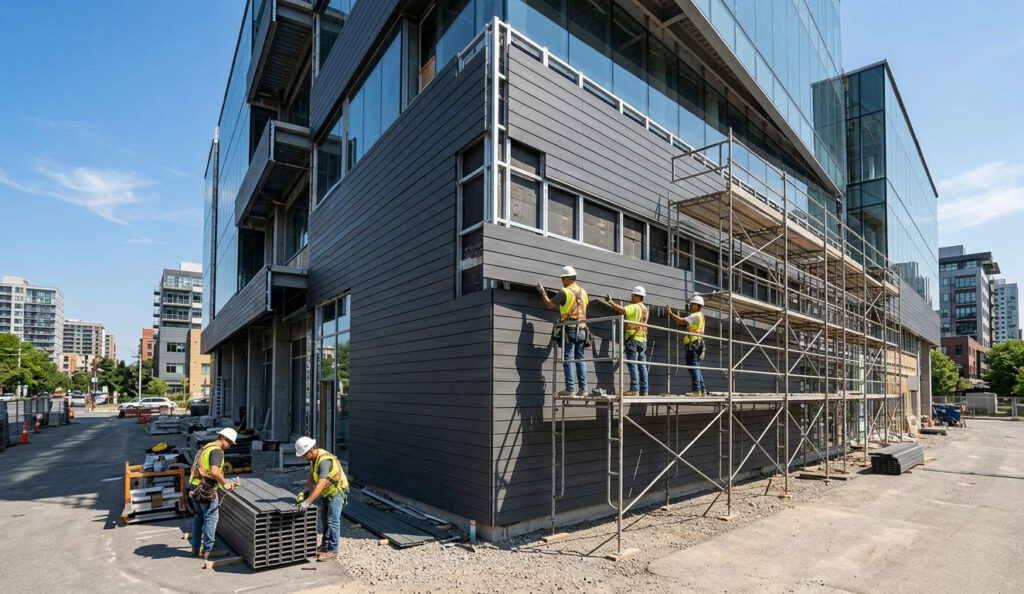
Beyond the material science, the commercial success of WPC Wall Cladding lies in its manufacturing flexibility. For large-scale developers, the ability to order custom lengths directly from the factory significantly reduces on-site waste.
Unlike natural wood, which is limited by the height of the tree, composite panels can be extruded to the exact specifications of a project’s elevation. This facilitates volume manufacturing efficiencies that lower the overall project cost. Furthermore, the installation efficiency of tongue-and-groove systems allows a two-person team to cover significantly more square footage per day compared to traditional siding methods.
Whether you are sourcing waterproof interior panels for a hotel renovation or durable exterior skins for a shopping mall, the ability to secure consistent quality through OEM manufacturing channels ensures that the aesthetic remains uniform across multiple project phases.


Maintenance and Long-Term Aesthetics
One of the hidden costs of building management is the “aesthetic upkeep.” Wood fades, stone stains, and metal can dent. WPC Wall Cladding is a through-body colored material. Even if the surface is scratched, the color remains consistent throughout the panel.
The UV resistant panels are treated with antioxidants that prevent the “chalking” effect seen in older PVC products. Maintenance is reduced to a simple periodic wash with water and mild detergent. When you factor in the saved costs of sanding, staining, and painting over a 20-year period, the ROI of WPC becomes undeniable.

Conclusion
The evolution of building materials has reached a point where we no longer have to sacrifice the warmth of wood for the durability of plastic. WPC Wall Cladding represents the perfect synthesis of nature and engineering. By addressing the core pain points of heat resistance and waterproofing, it provides a reliable, fire-safe, and low-maintenance solution for the modern built environment.
FAQ
Is WPC wall cladding suitable for coastal areas with high salt spray?
Yes. Because it is hydrophobic and contains no metal components in the panel itself, it is immune to salt-air corrosion and rot.
How does heat affect the lifespan of the panels?
High-quality WPC Wall Cladding is rated for continuous use in temperatures up to 70°C. UV stabilizers prevent the polymer from becoming brittle over time.
Can I order custom colors for large-scale projects?
Most manufacturers offering OEM manufacturing services can provide custom color matching for orders exceeding a specific square footage, typically 500-1000 square meters.
Is WPC cladding environmentally friendly?
Most WPC Wall Cladding is made from recycled wood fibers and reclaimed plastics, making it a sustainable alternative to harvesting old-growth timber.