
In the current global construction market, the “sticker price” of a material is a deceptive metric. To understand the true Wall Panel ROI, one must look at the entire lifecycle of a project—from substrate preparation to the final occupancy date. Traditional ceramic tiles have long been the industry standard, but their reliance on wet-trade labor makes them increasingly expensive in high-wage markets.
Modern SPC (Stone Plastic Composite) wall panels are engineered to solve the efficiency gap. By utilizing a high-density core and an interlocking click system, these panels eliminate several stages of the traditional installation workflow. When we calculate the Wall Panel ROI, we aren’t just measuring material durability; we are measuring the reduction of project downtime and the optimization of human capital.
Table of Contents
Total Cost of Ownership (TCO) Comparison
The primary driver of a superior Wall Panel ROI is the drastic reduction in labor intensity. Tiling requires a multi-step process: wall leveling, mortar application, tile setting, and finally, grouting and cleaning. Each step introduces a “curing period” that halts the project’s progress.
Conversely, the installation of SPC wall systems is a dry process. These panels can often be installed directly over existing substrates, including old tiles or raw masonry, provided the surface is structurally sound. This capability to bypass demolition is a massive contributor to the high Wall Panel ROI seen in hotel and office renovations, where every day of closure represents lost revenue.
| Cost Metric (Per 100 m2) | Traditional Ceramic Tiles | LY Panel SPC Wall System | Financial Impact |
| Substrate Preparation | Intensive Leveling/Demolition | Minimal (Direct Overlay) | -35% Labor Cost |
| Installation Speed | 5-7 Working Days | 1-2 Working Days | 70% Faster Turnaround |
| Adhesive/Grout Material | High Volume (Heavy Weight) | Low Volume (Pressure Sensitive) | Reduced Logistics Cost |
| Labor Skill Level | Specialized Tile Setter | General Carpenter/Installer | Lower Wage Burden |
| Post-Install Cleaning | Acid Wash/Grout Sealing | Zero (Immediate Occupancy) | Instant ROI Realization |
Data adapted from global construction labor trends. Source: U.S. Bureau of Labor Statistics – Occupational Outlook
Quantifying Labor Cost Savings with Wall Panels
Labor accounts for approximately 60% to 70% of a tiling project’s budget in North America and Europe. A significant part of the Wall Panel ROI equation is the “Man-Hour Per Square Meter” metric. A skilled tiler may complete 8–10 square meters per day, including grouting. An installer using LY Panel’s interlocking system can easily exceed 30–40 square meters in the same timeframe.
This efficiency doesn’t just lower the immediate invoice from the contractor; it lowers the indirect costs of project management, site insurance, and temporary utilities. When these factors are aggregated, the Wall Panel ROI becomes evident within the first 48 hours of a commercial renovation.
Technical Durability and Maintenance ROI
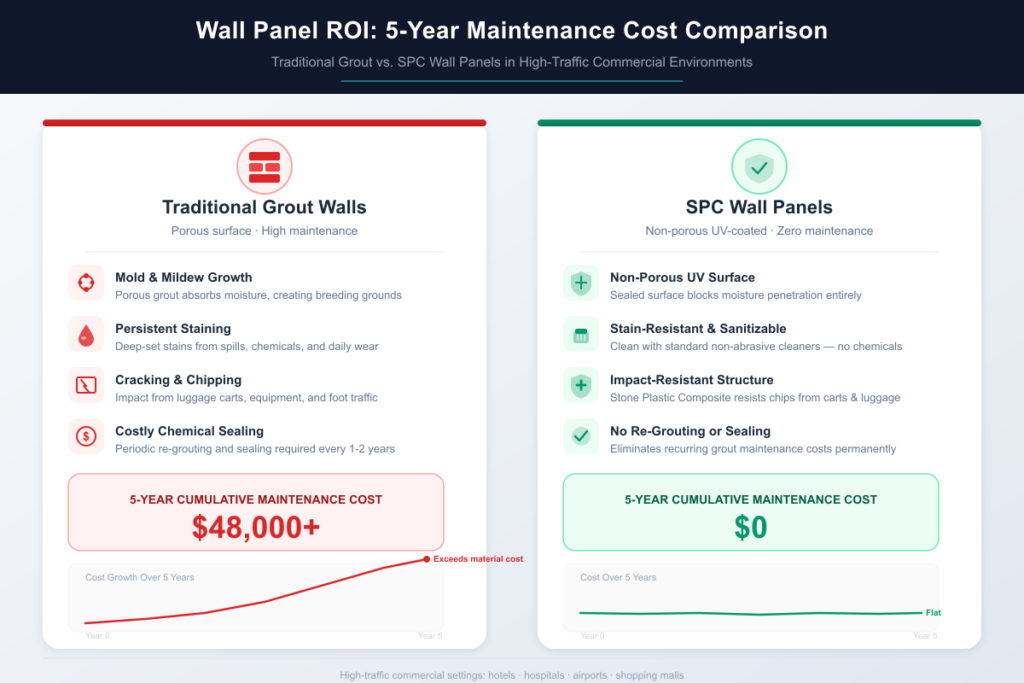
A long-term Wall Panel ROI is defined by how the material ages. Traditional grout lines are porous, making them susceptible to mold, staining, and cracking over time. In high-traffic commercial environments, such as hotel corridors or hospital lobbies, the cost of specialized deep cleaning for grout can exceed the original material cost within five years.
SPC wall panels feature a non-porous UV-coated surface. This engineering choice ensures that the material remains stain-resistant and easy to sanitize with standard non-abrasive cleaners. This “zero-maintenance” characteristic is a cornerstone of the Wall Panel ROI, as it eliminates the need for periodic re-grouting or chemical sealing. Furthermore, the impact resistance of SPC (Stone Plastic Composite) ensures that the panels do not chip or crack when struck by luggage or cleaning carts.
The “Live-In” Renovation Factor
One of the most overlooked aspects of Wall Panel ROI is the ability to perform renovations without fully closing a facility. Tiling creates significant dust (from cutting) and noise (from demolition), necessitating total area isolation. SPC wall panels can be cut with minimal dust and installed with low-odor adhesives.
For the hospitality industry, this means a hotel can renovate one wing while maintaining 80% occupancy in the other. This “Revenue Continuity” is perhaps the most powerful argument for a high Wall Panel ROI. Instead of a 30-day total shutdown, a floor can be refreshed and re-opened in 72 hours.
Environmental Compliance and Future Gains
Sustainability is no longer optional in commercial construction. Achieving a high Wall Panel ROI also involves meeting green building standards like LEED or BREEAM. Our SPC panels are 100% recyclable and Formaldehyde-free (E0 Grade). Avoiding the environmental “tax” of carbon-heavy cement-based mortars used in tiling further enhances the Wall Panel ROI for corporations looking to meet ESG (Environmental, Social, and Governance) goals.
Strategic Decision Making
Ultimately, the choice of material should be based on a cold calculation of the Wall Panel ROI. While tiles offer a traditional look, the associated labor volatility and maintenance overhead make them a high-risk investment for modern commercial developers. By switching to a high-performance SPC system, developers secure a predictable, high Wall Panel ROI that benefits the bottom line from day one.
In summary, the Wall Panel ROI is a multi-dimensional benefit involving labor reduction, speed of occupancy, and long-term durability. For any project aiming for 2026 completion standards, the math clearly favors integrated wall systems over traditional wet-trade alternatives.
FAQ
How does the initial material price affect the Wall Panel ROI?
While the raw material price per $m^2$ may be comparable to mid-range tiles, the Wall Panel ROI is realized through a 60% reduction in installation labor and the elimination of demolition costs.
Is the ROI lower for residential projects?
No. While the scale is smaller, the Wall Panel ROI remains high for homeowners due to the “DIY-friendly” nature of the product, saving thousands in professional contractor fees.
How do I verify the Wall Panel ROI for my specific project?
Use a Total Cost of Ownership (TCO) calculator. Factor in labor rates ($/hour), estimated days of closure, and 10-year maintenance projections.