
Office acoustic design is no longer a small detail in workplace planning. Open offices, glass meeting rooms, hybrid calls, shared focus zones, and hard interior surfaces have changed how sound behaves at work. This article explains why basic soundproofing is not enough, how acoustic panels and wall solutions support workplace noise control, and what buyers should check before choosing office acoustic panels.
Table of Contents
Why Is Office Acoustic Design Becoming More Important?
Modern workplaces are more flexible than before. Teams move between open desks, video calls, meeting rooms, focus rooms, lounges, and shared collaboration areas. That flexibility creates a sound problem: one space often carries many different activities at the same time.
This is why office acoustic design is becoming more important in 2026. Noise is not only an annoyance. It affects concentration, speech clarity, call quality, meeting efficiency, privacy, and the way employees experience the workplace.
The CDC’s NIOSH page on understanding workplace noise exposure notes that noise levels can become a problem when people need to raise their voice to talk at arm’s length. Offices are not usually as loud as industrial sites, but the same principle is useful: if people must work harder to communicate or concentrate, the sound environment needs attention.
For interior designers, facility managers, and office renovation teams, the question is no longer “Can we block all noise?” The better question is: “Can we shape sound so people can focus, talk, meet, and move through the office without constant distraction?”
Soundproofing vs Acoustic Design: What Is the Real Difference?
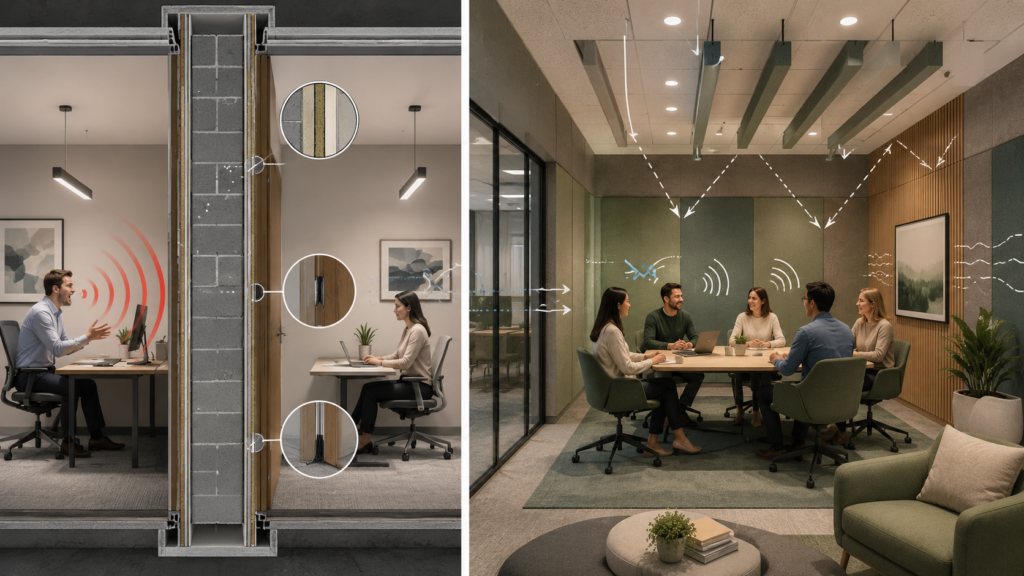
Soundproofing and office acoustic design solve different problems.
Soundproofing is about blocking sound from entering or leaving a room. It often involves heavier walls, sealed gaps, acoustic doors, glazing systems, and construction-level separation.
Acoustic design is about improving how sound behaves inside the space. It deals with echo, reverberation, speech clarity, sound reflection, and noise spread.
The Wikipedia article on acoustics defines acoustics as the science of mechanical waves in gases, liquids, and solids, including sound and vibration. In office interiors, that science becomes very practical: hard glass, concrete, ceilings, floors, and walls reflect sound unless they are balanced with absorptive materials.
Many offices do not need full sound isolation. They need better acoustic treatment. That means acoustic wall solutions, ceiling absorbers, partitions, furniture, layout planning, and soft surfaces working together.
Basic soundproofing may reduce sound transfer between rooms, but office acoustic design helps the room itself sound better.
Why Do Open Offices Need Acoustic Panels?
Open offices need acoustic panels because speech noise travels easily across shared spaces. A conversation near one desk can disturb another team. A video call can leak into a focus zone. Hard surfaces can make small sounds feel sharper and more tiring.
ISO 3382-3 is specifically focused on room acoustic parameters in open-plan offices. The ISO page for ISO 3382-3:2022 explains that the standard specifies a method for measuring room acoustic parameters in unoccupied open-plan offices. That matters because open office acoustics can be measured and planned, not guessed.
In open workplaces, office acoustic panels can help absorb reflected sound and reduce the “live” feeling of the space. They are not magic. They work best when placed near noise sources, conversation zones, reflective walls, and areas where employees need more control.
Common open office noise problems include:
- speech distraction from nearby teams
- echo from glass walls and hard floors
- video meeting spillover
- noise from collaboration areas
- lack of focus zones
- poor acoustic separation between work modes
For a broader design view, this guide to acoustic panels in modern interiors explains how acoustic panels can support both interior style and sound control.
How Does Office Acoustic Design Improve Focus and Productivity?
Office acoustic design improves focus by reducing unnecessary sound reflection and controlling how speech spreads across the workspace. It does not need to make the office silent. In fact, complete silence is rarely the goal in a modern workplace.
The goal is balance.
Open work areas need enough acoustic control to reduce speech distraction. Meeting rooms need clarity. Focus rooms need quiet. Reception areas need comfort. Corridors should not become echo tunnels.
A practical way to think about it:
| Office Problem | Acoustic Design Value |
|---|---|
| Speech distraction | Reduces sound reflection and spread |
| Echo in meeting rooms | Improves speech clarity |
| Open office noise | Creates more controlled sound zones |
| Poor call quality | Supports better hybrid meeting experience |
| Hard interior surfaces | Adds absorption without changing the layout |
WELL’s article on what is new in WELL v2 Sound explains that the Sound concept addresses noise control and intentional acoustic design, including planning, HVAC, façade design, speech intelligibility, and acoustic privacy. That is exactly why office acoustic design should be handled as a workplace strategy, not only a decoration choice.
Why Are Meeting Rooms a Key Part of Office Acoustic Design?
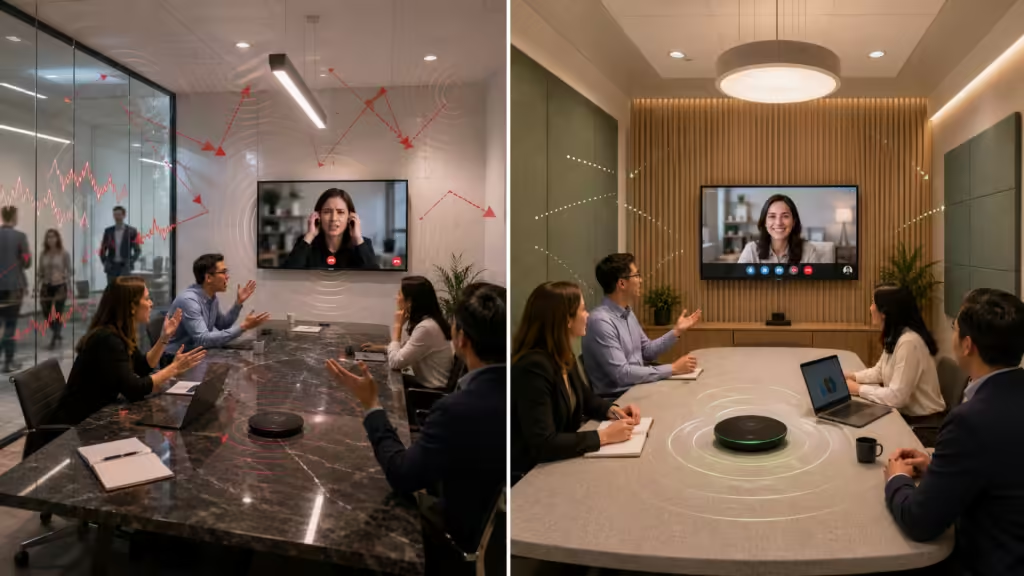
Meeting rooms are where poor acoustics become obvious. If the room has hard walls, a glass partition, a large table, and no absorption, voices bounce around. People talk louder. Remote participants hear echo. Decision-making feels slower because communication is less clear.
That is why meeting rooms should not be treated as separate from office acoustic design. They are often the highest-impact acoustic zones in the office.
Common meeting room problems include:
1.echo during discussion
2.poor speech clarity
3.video call feedback
4.confidential speech leakage
5.voice fatigue during long meetings
6.sound reflections from glass and hard furniture
If you are planning meeting spaces, this guide to acoustic panels for meeting rooms explains how panel placement, wall coverage, and room function affect clarity.
Office acoustic panels in meeting rooms should support speech, not just reduce noise. The goal is clear conversation, comfortable listening, and better hybrid meeting performance.
How Can Acoustic Wall Solutions Fit Modern Office Interiors?
Many companies avoid acoustic treatment because they imagine thick, plain, industrial-looking materials. That is no longer necessary. Acoustic wall solutions can now support both performance and interior design.
Office acoustic design should match the space. A reception area may need softer visual finishes. A meeting room may need clean wall coverage. An open office may need panels that blend with brand colors. A corridor may need durable acoustic surfaces that reduce echo without looking out of place.
Design options can include:
- fabric-wrapped acoustic panels
- polyester acoustic panels
- decorative wall tiles
- custom shapes
- color-matched panels
- acoustic ceiling baffles
- modular acoustic wall solutions
This is where acoustic performance and interior design meet. A workspace should sound better without feeling like a studio or factory.
For designers working with modern interiors, acoustic panels in modern interiors can help connect sound absorption with color, texture, and visual identity.
What Should Buyers Check Before Choosing Office Acoustic Panels?
Before choosing office acoustic panels, buyers should first define the noise problem. Do not start with color or price. Start with the room.
A practical checklist:
1.Is the space an open office, meeting room, corridor, or focus room?
2.Is the problem echo, speech distraction, privacy, or call quality?
3.Are the main surfaces glass, concrete, drywall, or ceiling tiles?
4.How much wall or ceiling area is available?
5.Is the office already furnished?
6.What panel thickness is suitable?
7.Is fire performance required?
8.Do panels need custom color or shape?
9.Can installation happen during renovation or after move-in?
10.Is long-term cleaning and durability important?
WELL’s page on sound reducing surfaces lists NRC-related requirements for vertical surfaces in offices, conference rooms, and open workspaces. This is useful because buyers should look beyond appearance and ask how much sound absorption the material actually provides.
If you are comparing materials, this polyester acoustic panels buying guide can help buyers review panel thickness, density, color, installation, durability, and application fit.
Buyer Insight: A beautiful panel that does not solve the room’s real sound problem is still the wrong panel.
Office Acoustic Design Trends 2026: What Is Changing?
Office acoustic design trends in 2026 are moving away from single-product fixes. More workplaces are using sound zoning, meeting room treatment, decorative acoustic walls, modular panels, and acoustic surfaces that fit interior style.
Several trends are becoming clear:
- acoustic panels are being integrated into interior design
- open offices use more sound zoning
- meeting rooms are designed for hybrid communication
- focus rooms and quiet zones are becoming more common
- acoustic wall solutions are becoming more decorative
- recycled and polyester acoustic materials are getting more attention
- renovation-friendly acoustic panels are in higher demand
The office is no longer one acoustic environment. It is a mix of work modes. That is why office acoustic design must consider where people talk, where they focus, where they meet, and where sound should be softened.
In 2026, the stronger design question is not “How do we make the office quiet?” It is “How do we make each work zone sound right?”
Where Should Acoustic Panels Be Used in an Office?
Acoustic panels for open offices are important, but they are not the only application. Different office areas need different acoustic priorities.
| Office Area | Acoustic Priority |
|---|---|
| Open office | Reduce speech distraction |
| Meeting room | Improve speech clarity |
| Reception area | Control echo and improve comfort |
| Corridor | Reduce sound reflection |
| Focus room | Support quiet work |
| Breakout area | Control casual conversation noise |
| Phone booth area | Improve call comfort |
| Training room | Support clear speaking and listening |
This is where office acoustic design becomes more useful than basic soundproofing. Instead of treating every room the same way, the design responds to each space’s function.
A meeting room needs clarity. A focus room needs calm. A reception area needs comfort. An open office needs reduced noise spread. The right acoustic wall solutions should match those different needs.
Final Advice
The future of workplace noise control is not about making every office silent. It is about designing the right sound environment for each activity.
Office acoustic design helps connect open office comfort, meeting room clarity, focus work, hybrid calls, employee experience, and interior design. Office acoustic panels, workplace noise control, and acoustic wall solutions all work better when they are part of one plan.
Basic soundproofing can still be useful when a room needs isolation. But modern workplaces usually need something more practical: a sound environment that supports how people actually work. That is why office acoustic design should be treated as part of workplace strategy, not a last-minute finish.
FAQ
What is office acoustic design?
Office acoustic design is the planning of sound control inside a workplace to reduce noise, manage echo, improve speech clarity, and support focus and communication.
Is office acoustic design the same as soundproofing?
No. Soundproofing blocks sound from entering or leaving a space. Acoustic design improves how sound behaves inside the room.
Do open offices need acoustic panels?
Yes. Open offices often have speech noise, hard surfaces, and sound reflections. Acoustic panels can help reduce echo and improve comfort.
Where should acoustic panels be placed in an office?
Common locations include open work areas, meeting rooms, focus rooms, reception areas, corridors, and walls near frequent conversation zones.
What are the best acoustic panels for meeting rooms?
Panels with strong sound absorption, suitable thickness, fire performance, and interior-friendly finishes are usually preferred for meeting rooms.