
Acoustic panels for meeting rooms are not just a wall decoration choice. In many offices, meetings fail because people cannot hear clearly, video calls pick up room echo, and voices become muddy after bouncing between glass, drywall, ceilings, and hard floors.
This guide explains how acoustic panels for meeting rooms improve speech clarity, reduce echo, support hybrid meetings, and make the room look more finished. It also helps buyers understand where to place meeting room sound panels, what to check before purchase, and how to avoid common acoustic mistakes.
Why Meeting Rooms Often Sound Worse Than They Look
Modern meeting rooms are designed to look clean: glass walls, hard tables, painted drywall, exposed ceilings, tile floors, and large screens. Visually, that can work. Acoustically, it often creates problems.
Sound reflects from hard surfaces. When speech keeps bouncing around the room, listeners hear both the direct voice and delayed reflections. The result is echo, longer reverberation, and lower speech clarity. NRC Canada’s paper on acoustical design of rooms for speech explains that speech intelligibility depends strongly on reverberation time and ambient noise levels.
This is why acoustic panels for meeting rooms should be considered early in office planning, not only after complaints begin. The goal is not to make the room silent. The goal is to make speech easier to understand.
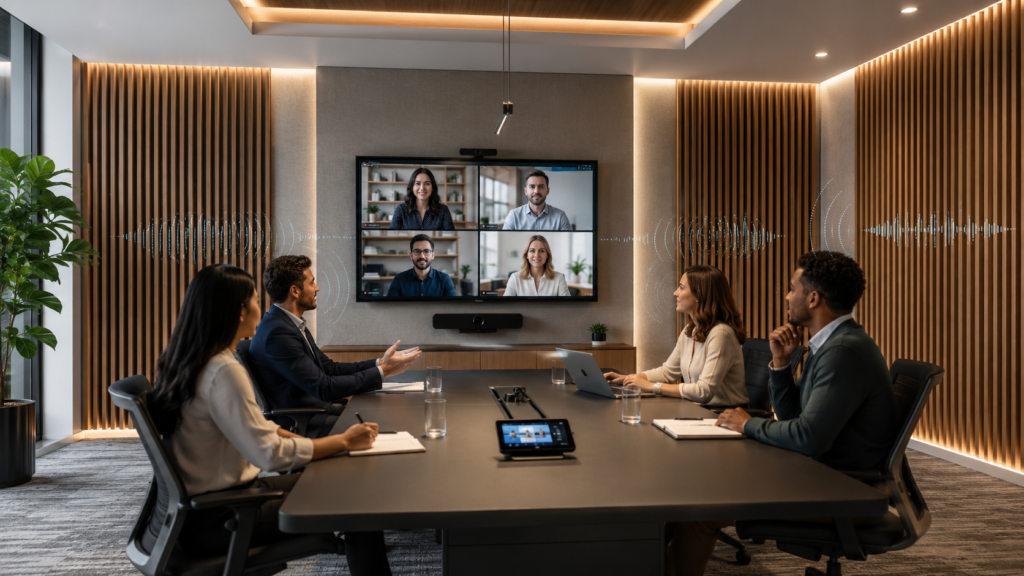
How to Reduce Echo in Meeting Rooms Without Over-Treating the Space
The question many facility managers ask is simple: how to reduce echo in meeting rooms without making the space feel flat or over-treated?
The answer is controlled absorption. Acoustic panels absorb part of the reflected sound energy, reducing excessive echo and shortening the sound tail after someone speaks. Wikipedia’s article on acoustic panels describes them as sound-absorbing panels used to control echo and reverberation, often to address speech intelligibility issues.
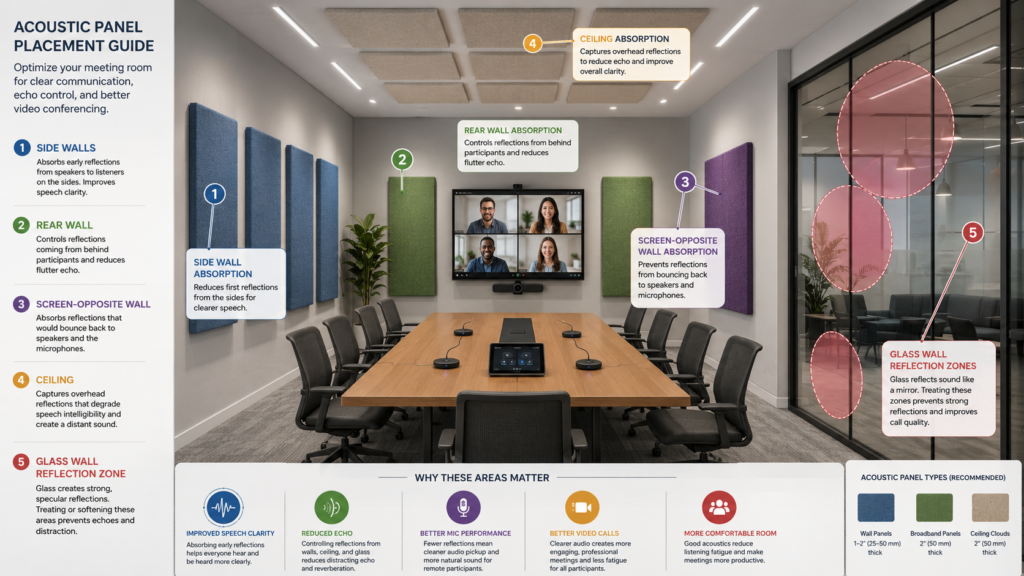
Acoustic panels for meeting rooms work best when placed near reflection points. These are usually side walls, back walls, the wall opposite the display, and sometimes the ceiling. A small decorative patch on one wall may look good, but it may not solve the acoustic problem.
Why Speech Clarity Panels Matter for Hybrid Meetings
In hybrid meetings, poor acoustics affect both people in the room and people online. Microphones do not only capture the person speaking. They also pick up reflected sound from walls, glass, ceilings, and the conference table.
That is why speech clarity panels matter. They reduce the amount of reflected speech that reaches the microphone, helping remote participants hear cleaner audio. AV Network’s article on audio in modern meeting rooms notes that hard surfaces and glass walls can create echo, reverberation, and poor speech intelligibility in hybrid collaboration spaces.
Acoustic panels for meeting rooms can also reduce meeting fatigue. When people do not need to repeat themselves or strain to follow the conversation, meetings feel more efficient.
Where to Install Meeting Room Sound Panels for Better Results
Placement is often more important than people expect. Meeting room sound panels should support the way people speak, listen, and join video calls.
Start with these areas:
1.Side walls beside the conference table
These surfaces often create strong early reflections.
2.Rear wall behind listeners
A hard rear wall can send sound back across the table.
3.Wall opposite the display or presenter
This area often reflects speech toward microphones.该
4.Glass-heavy areas
Glass is highly reflective, so rooms with glass walls usually need more absorption elsewhere.
5.Ceiling zones in larger rooms
If wall space is limited, ceiling absorption may help control reverberation.
Acoustic panels for meeting rooms should be planned around actual seating, microphone position, camera direction, and wall material.
Acoustic Wall Panels for Conference Rooms: Sound Control and Design
Acoustic wall panels for conference rooms should solve sound problems without making the office look like a recording studio. Modern office acoustic panels can be part of the interior design instead of an afterthought.
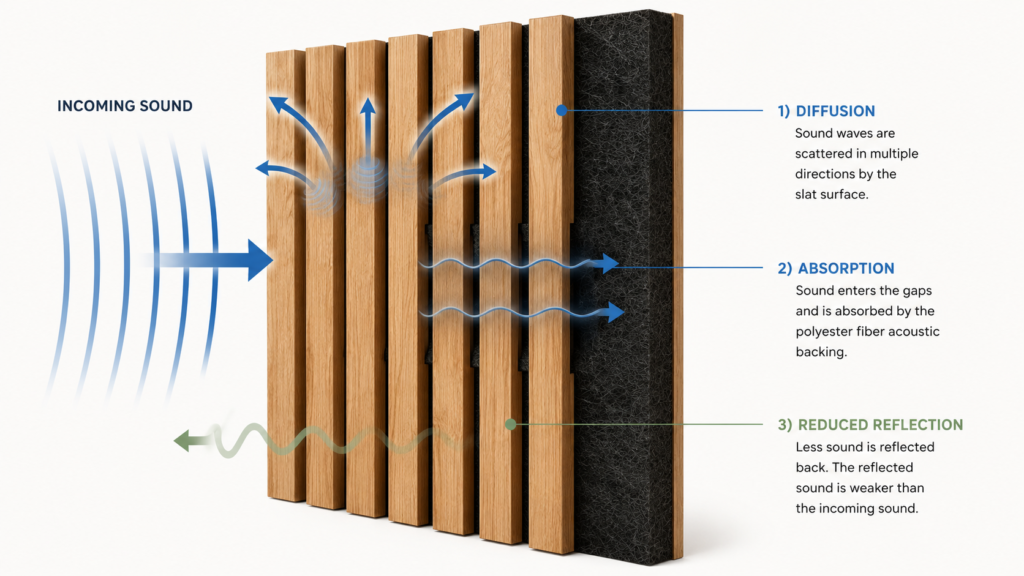
For offices that want acoustic treatment to also support wall design, polyester fiber wood strip acoustic panels can be used as acoustic wall panels for conference rooms. They help reduce reflected sound while adding a warmer, more structured wall finish.
This is where acoustic panels for meeting rooms become useful for both performance and appearance. They can support speech clarity, video calls, and a more professional meeting environment.
For a broader look at how panels support office, commercial, and residential spaces, see our guide to acoustic panels in modern interiors.
Office Acoustic Panels vs Basic Wall Decoration
Basic wall decoration does not always improve room acoustics. A wood veneer panel, glass partition, or decorative board may look premium, but if it does not absorb sound, it may still reflect speech back into the room.
Office acoustic panels are different because they are designed to absorb sound energy. The GSA Sound Matters guide for contemporary offices emphasizes that acoustical comfort should be considered as part of planning, design, specification, and construction, not treated as a quick fix later.
Acoustic panels for meeting rooms should be selected for both acoustic performance and design fit. Color, texture, pattern, thickness, and installation method matter, but they should not replace absorption performance.
How to Choose Acoustic Panels for Meeting Rooms
When comparing acoustic panels for meeting rooms, buyers should ask practical questions instead of choosing by appearance alone.
Check these points:
- Acoustic performance: Does the panel absorb sound or only decorate the wall?
- Panel thickness: Thicker or better-designed panels often perform better at useful speech frequencies.
- Material: Polyester fiber, fabric, wood strip, and composite designs can fit different office styles.
- Fire rating: Commercial office projects may require fire-safe materials.
- Wall coverage: Too little coverage may not reduce echo enough.
- Installation method: Adhesive, clips, rails, or modular systems should match the wall condition.
- Finish and color: The panel should fit the brand style and meeting room design.
- Maintenance: Office surfaces should be durable and easy to clean.
- Customization: Room size, wall layout, and project design may require custom dimensions.
Acoustic panels for meeting rooms should be chosen as part of the room system: walls, ceiling, floor, furniture, glass, doors, microphones, and screens all influence the final experience.
Common Mistakes When Treating Meeting Room Echo
Many meeting rooms still sound bad after renovation because acoustic treatment was added without a plan.
Common mistakes include:
- installing panels only as a TV background wall;
- ignoring glass walls;
- relying only on carpet;
- choosing panels only by color;
- placing panels away from reflection points;
- forgetting microphone pickup areas;
- treating every meeting room with the same layout;
- using too little wall coverage;
- ignoring ceiling reflections in larger rooms.
Acoustic panels for meeting rooms are most effective when they are placed where sound reflections actually happen.
Do Meeting Room Sound Panels Help Video Calls?
Yes. Meeting room sound panels can improve video calls because they reduce room reflections before sound reaches the microphone. This does not replace good microphones, speaker placement, or conferencing software, but it gives the audio system a cleaner room to work with.
Conclusion
Acoustic panels for meeting rooms help solve a common office problem: rooms that look professional but sound unclear. By reducing reflections, improving speech clarity, supporting video calls, and adding a cleaner wall finish, they make meetings easier to follow and more comfortable to attend.
The best results come from choosing acoustic panels for meeting rooms based on room size, reflection points, material, performance, installation method, and design goals. When the acoustic plan supports the way people actually meet, talk, and connect online, the room becomes more useful every day.
FAQ
Do acoustic panels work in meeting rooms?
Yes. Acoustic panels absorb reflected sound, reduce echo, and improve speech clarity. They work best when installed on the right wall or ceiling areas.
How do I reduce echo in a conference room?
Start with the main reflection points: side walls, rear wall, glass-heavy areas, and sometimes the ceiling. Use acoustic wall panels for conference rooms together with soft furnishings when needed.
Where should acoustic panels be placed in a meeting room?
Place them near reflection points around the conference table, behind listeners, opposite hard walls, and near glass areas. Large rooms may also need ceiling absorption.
How many acoustic panels does a meeting room need?
It depends on room size, ceiling height, glass area, furniture, wall surfaces, and the level of echo. Too few panels may look decorative but fail to improve speech clarity.
Are office acoustic panels good for video calls?
Yes. Office acoustic panels reduce reverberation and echo, helping microphones capture cleaner speech for remote participants.
Can acoustic panels also be decorative?
Yes. Modern acoustic panels can use wood strip designs, fabric finishes, colors, and modular layouts, so they improve both sound and wall appearance.