
Sourcing high quality wall panels is a critical skill for any procurement manager handling commercial developments. In a market saturated with visually identical budget options, relying solely on a supplier’s marketing brochure often leads to catastrophic project failures, such as warping, delamination, and severe off-gassing.
When specifying materials for interior wall cladding, engineers must evaluate the product through a rigid, data-driven framework. Knowing exactly how to identify high quality wall panels prevents premature material failure and mitigates long-term liability. This professional guide breaks down the essential field tests and technical metrics required to audit potential suppliers and secure premium composite materials.
Table of Contents
Method 1: The “Cross-Cut” Surface Adhesion Test
The first checkpoint to identify high quality wall panels involves inspecting the surface film. The industry utilizes several wall panel surface coating types, ranging from basic PVC cold-pressing to advanced UV-cured coatings. Budget panels use inferior adhesives that fail under thermal stress.
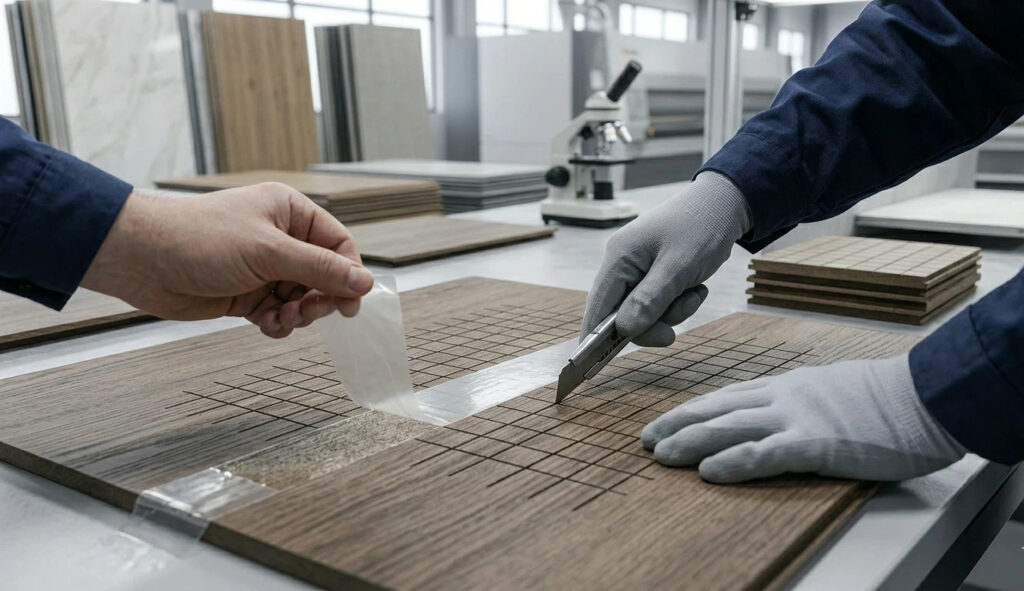
To verify if you have high quality wall panels, perform a “Cross-Cut Test” on-site. Score a grid into the surface finish using a utility knife, apply industrial-grade tape, and pull it off rapidly. If the decorative film flakes or pulls away, the lamination process is compromised. Premium panels will exhibit zero finish detachment, indicating a permanent bond.
Method 2: The “30-Minute Boiling” Hydrophobic Test
The substrate density dictates the structural integrity of high quality wall panels. Modern WPC wall panels rely on a specific ratio of virgin polymer resins to fine wood fibers. Low-density cores often contain excessive recycled plastics, resulting in high brittleness.
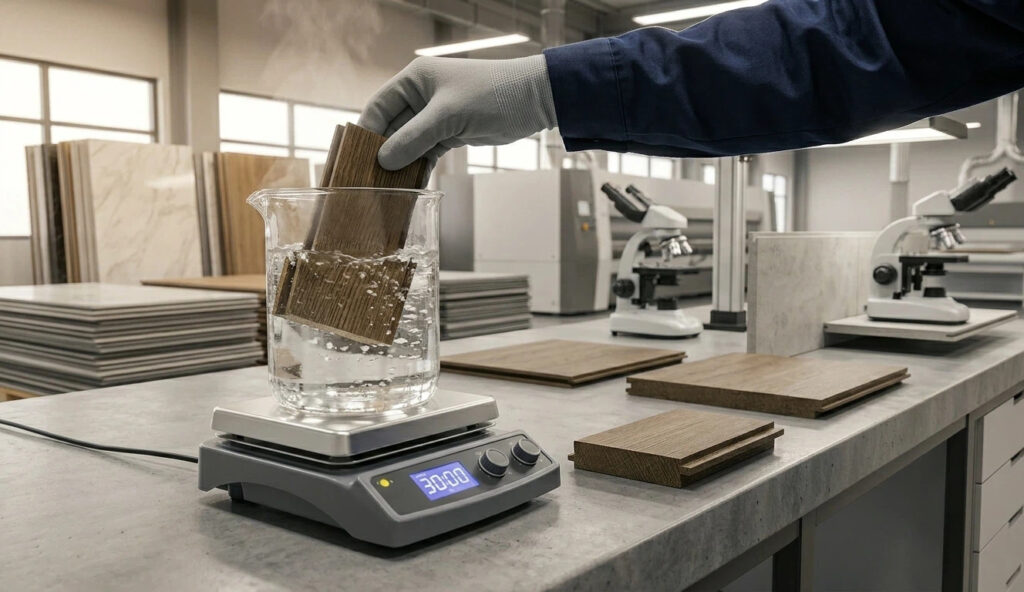
True high quality wall panels maintain water absorption rates below 1%. You can test this by completely submerging a cross-section sample in boiling water for 30 minutes. An inferior panel will swell and crumble at the edges. A premium panel will maintain its dimensional stability and sharp edges, proving its viability for high-humidity commercial environments.
Method 3: The “Sealed Bag” VOC Sniff Test
For indoor environments, high quality wall panels must prioritize formaldehyde control.Understanding the gap between E0 vs E1 wall panel standards is mandatory for compliance.While E1 (0.124 mg/m3) is the baseline, EO (0.050 mg/m3) is the benchmark for eco-friendly wall panels.
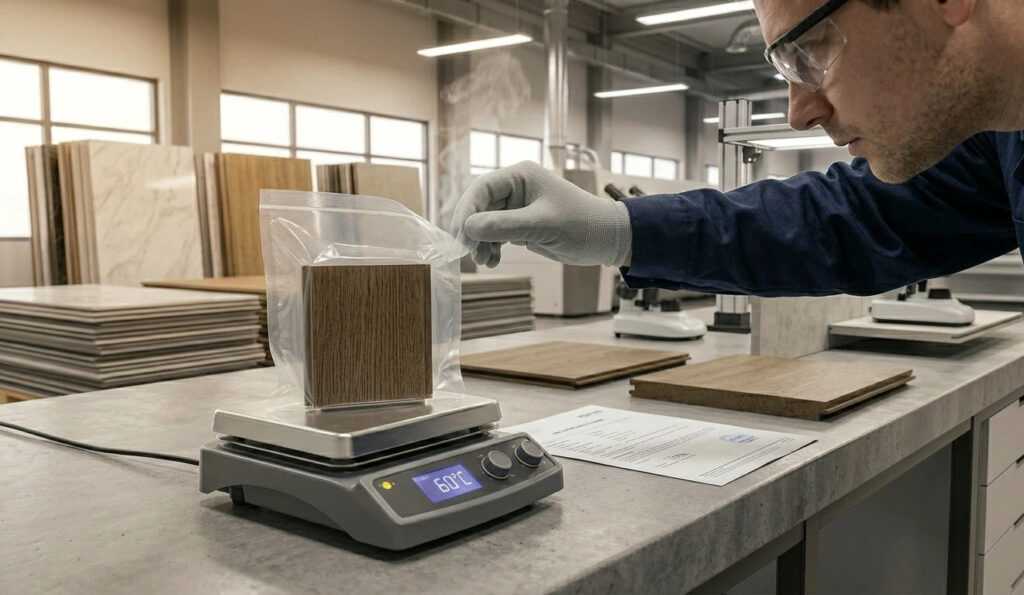
You can identify high quality wall panels by sealing a sample in an airtight bag and placing it in a 60°C environment for one hour. Upon opening, inferior panels will release a sharp, irritating chemical odor. A premium E0 panel will yield only a faint, natural resin scent. Always demand third-party lab verification (SGS/Intertek) for these claims.
Authority Reference: For standardized methodologies, refer to ASTM D1037: Standard Test Methods for Evaluating Properties of Wood-Base Fiber and Particle Panel Materials. This document dictates the physical testing protocols that reputable manufacturers follow.
Method 4: The “Light-Gap” Precision Alignment Test
The tongue and groove mechanisms in high quality wall panels are milled with strict CNC precision. Poorly machined edges require installers to force panels together, creating tension that leads to buckling.
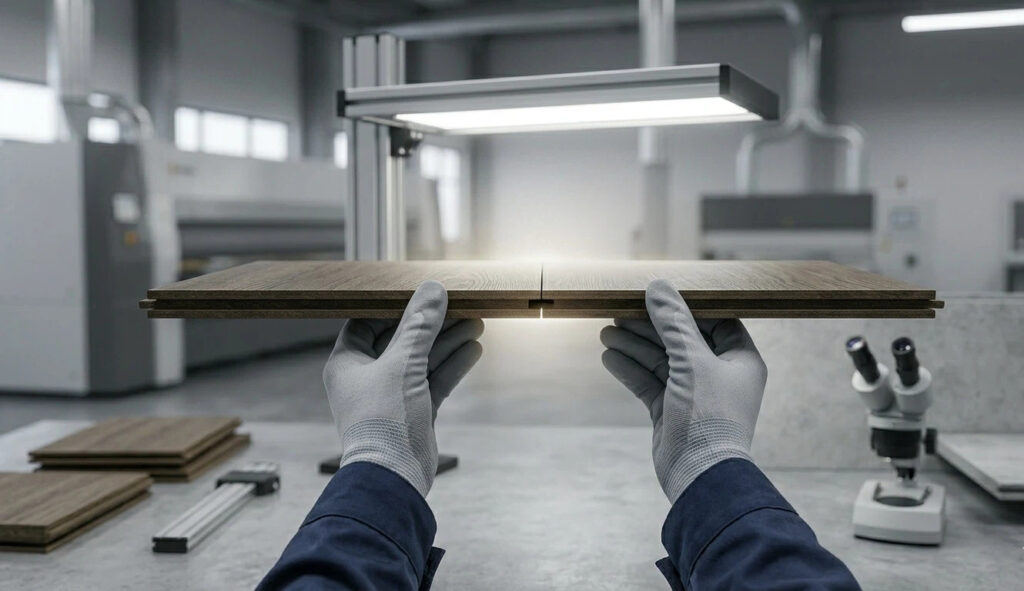
Uneven gaps are a clear indicator that you are not installing high quality wall panels. Perform a “Light Gap Test” by snapping two sample pieces together and holding the seam up to a strong light source. If light passes through the joint, the extrusion dies used by the wall panel manufacturer are worn out. Premium panels lock together seamlessly with a tolerance of less than 0.1mm.
Method 5: The “Batch Variance” Supply Audit
Even if a sample passes every test, securing high quality wall panels at scale requires vetting the factory infrastructure. Sourcing materials for a 50,000-square-meter project requires a supplier capable of maintaining absolute consistency.
When auditing a supplier, focus on their capacity for large-scale wall panel project delivery. Request documentation on their automated mixing systems. A supplier capable of delivering massive volumes without color drift is the final safeguard in your procurement strategy. Ensuring batch-to-batch consistency is the hallmark of high quality wall panels.
Final Verdict
Identifying high quality wall panels is an exercise in technical verification. By utilizing the five methods outlined above—from adhesion tests to supply audits—you ensure that the specified materials will perform flawlessly. For those seeking a benchmark, the High Quality Wall Panels from LY Panel represent the intersection of precision engineering and sustainable design.
FAQ
What is the optimal density for WPC interior panels?
A density exceeding 850 kg/m’ provides the necessary impact resistance and screw-holding strength for commercial applications.
Can I use standard WPC panels in commercial bathrooms?
Only if the panels are certified hydrophobic. Boiling water tests must confirm a water absorption rate of less than 1% to prevent structural swelling.
How do I verify a manufacturer’s E0 formaldehyde claim?
Request a valid third-party laboratory report that references the exact product batch using the desiccator or chamber test method.