
Spatial design in 2026 is no longer about filling a room; it is about refining the atmosphere. In an era where “Quiet Luxury” and “Sensory Minimalism” dominate the architectural landscape, vertical surfaces have become the primary tool for defining character. Modern Wall Panels are now at the forefront of this movement, offering a sophisticated alternative to traditional finishes that often lack depth or functional longevity.
To understand why architects are moving away from paint and wallpaper, we must look at how Modern Wall Panels integrate texture, acoustics, and structural efficiency into a single, cohesive system.
Table of Contents
The Philosophy of Minimalism in Vertical Surfaces
Minimalism is frequently misunderstood as a lack of content. In professional spatial design, it is the deliberate curation of high-quality materials that speak through their inherent texture. The integration of Modern Wall Panels allows designers to create expansive, uninterrupted surfaces that eliminate the visual “noise” of seams and uneven textures.
Using minimalist interior wall panels creates a sense of continuity. Whether utilizing large-format stone composites or matte-finished polymers, these systems allow walls to recede into the background while providing a tactile warmth that paint cannot replicate. In high-end residential projects, the goal is “seamless integration”—where the wall becomes part of the architecture rather than a mere boundary.
Slat Wall Design: The Geometry of Shadow and Sound
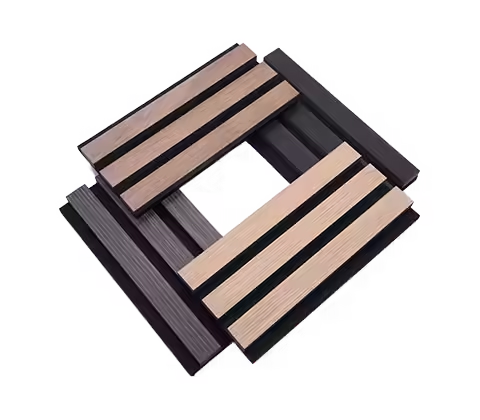
Perhaps the most influential trend in the current market is the slat wall design. This approach utilizes rhythmic, vertical lines to create a dynamic interplay of shadow and light. Unlike flat surfaces, a Modern Wall Panels system in a slat configuration adds three-dimensional depth to a room without compromising the minimalist ethos.
Beyond aesthetics, slat wall design serves a critical functional purpose: acoustics. High-performance Modern Wall Panels often incorporate an acoustic felt backing (usually made from recycled PET). This is particularly vital in open-plan layouts where sound reverberation can compromise the “zen” atmosphere of a minimalist space.
Authority Reference: According to the Acoustical Society of America, surface geometry—specifically vertical ribbing—significantly diffuses sound waves, reducing standing waves in rectangular rooms. Source: Acoustical Society of America
Engineering Durability: Commercial Interior Cladding
In the B2B sector, the focus shifts from pure aesthetics to life-cycle costs. Commercial interior cladding must withstand high-traffic environments, from hotel lobbies to corporate headquarters, without showing signs of wear. This is where the technical superiority of Modern Wall Panels becomes evident.
For large-scale projects, Modern Wall Panels provide a level of impact resistance that traditional drywall simply cannot provide. Furthermore, commercial interior cladding systems are now engineered for rapid installation. Modular systems allow for panels to be replaced individually if damaged, a feature that significantly reduces long-term maintenance overhead for facility managers.
Technical Compliance and Material Innovation
When specifying Modern Wall Panels for public spaces, safety is the paramount concern. Modern material science has allowed for the development of fire-rated composites that do not sacrifice design flexibility.
Most premium Modern Wall Panels are now tested against rigorous standards like ASTM E84. These Class A fire-rated systems ensure that even the most avant-garde minimalist interior wall panels are compliant with international building codes. This technical assurance is a key reason why Modern Wall Panels have become the standard for luxury hospitality design.
Authority Reference: The NFPA (National Fire Protection Association) outlines the necessity for fire-resistive interior finishes in high-occupancy commercial structures. Source: NFPA 101 Life Safety Code
Lighting as a Design Catalyst
The final impact of Modern Wall Panels is heavily dictated by lighting. In minimalist design, “grazing” light is used to emphasize the texture of the panel. By placing LED strips at the top or bottom of a Modern Wall Panels installation, the subtle undulations of the material are brought to life.
For slat wall design, lighting creates a high-contrast environment that accentuates the verticality of the space. This technique is often used in corporate boardrooms to create a focal point behind the primary podium or screen, proving that Modern Wall Panels are as much a lighting tool as they are a structural one.
Sustainability and the Future of Cladding
As we move toward a carbon-neutral construction industry, the materials used in Modern Wall Panels are coming under intense scrutiny. The industry is seeing a shift toward “Bio-materials” and recycled WPC (Wood Plastic Composite).
A high-quality Modern Wall Panels system today is often 100% recyclable. By choosing Modern Wall Panels made from sustainable sources, architects can achieve LEED or BREEAM certifications for their projects. This environmental responsibility is no longer an “extra”—it is a core requirement of modern procurement.
FAQ
Are Modern Wall Panels suitable for high-humidity areas like bathrooms?
Yes, provided they are made from moisture-resistant materials like PVC, WPC, or treated stone composites. Many minimalist interior wall panels are specifically designed for “wet zone” applications.
How does slat wall design improve office productivity?
By reducing acoustic distractions and creating a visually organized environment, slat wall design helps employees maintain focus, a key principle in modern workplace psychology.
Can commercial interior cladding be installed over existing surfaces?
In many cases, yes. Modern Wall Panels can be mounted onto existing substructures, which is ideal for retrofitting and renovation projects where time is a constraint.