
Table of Contents
How acoustic wood panels work is a common question from owners and acoustic consultants in international projects. This article explains, from an engineering and procurement perspective, how acoustic wood panels function to control reverberation and contribute to sound insulation, and it gives practical design and testing guidance for commercial and performance spaces.
How acoustic wood panels work —overview and soundproofing definition
Understanding how acoustic wood panels work starts with a clear distinction between sound absorption and sound insulation. A typical wood acoustic panel is a decorative face layer bonded to a functional absorber and, frequently, a backing cavity. Together these elements reduce reflected energy inside a room and increase transmission loss through partitions. Project objectives should include both improved speech intelligibility and measurable gains in airborne sound insulation.
How acoustic wood panels work —why they absorb sound (porous dissipation)
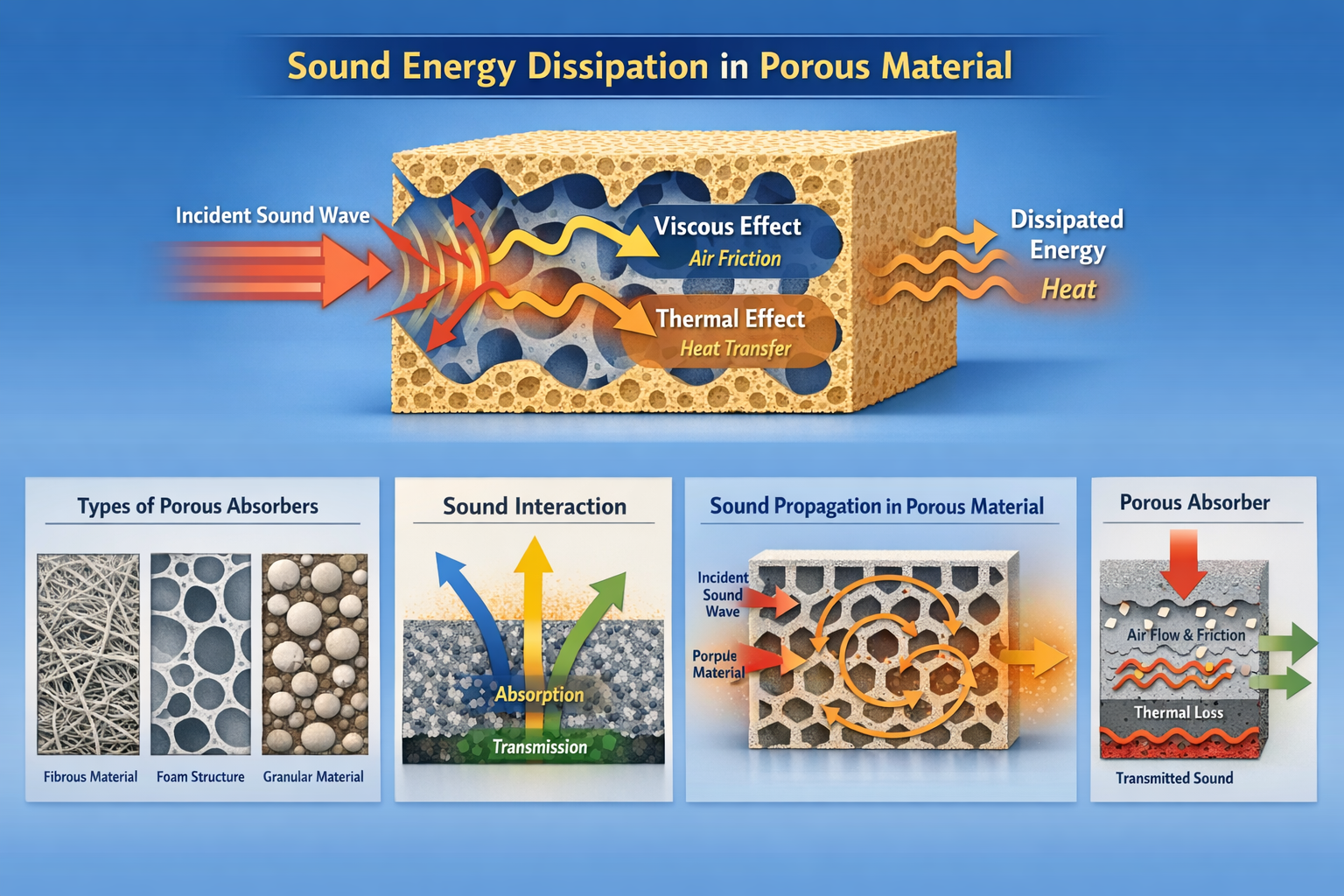
Porous absorbers such as mineral wool, glass fiber, or polyester rely on viscous and thermal dissipation as air moves through microscopic pores. When incident sound penetrates the absorber, friction and heat exchange convert acoustic energy into heat, lowering the reflected energy and shortening reverberation time. Accounting for absorption coefficients across frequency bands is essential; laboratory measurement methods (reverberation room tests per ISO 354) provide the reliable α(f) curves used in acoustic modeling.
How they provide sound insulation (transmission loss mechanisms)
Sound insulation is governed primarily by transmission loss and the impedance mismatch between layers. Wood panels can improve transmission loss by adding mass (mass law), decoupling structural paths with resilient mounts, and interrupting direct solid-to-solid transmission. Combining a decorative wood face with a separated absorbing layer and a ventilated cavity increases the overall partition impedance, producing better airborne sound reduction across design frequencies.
Microperforated panels and resonant units
Microperforated panels (MPP) and slotted wood elements create a resistive acoustic impedance that can be tuned by aperture diameter, perforation ratio, and plate thickness. Based on Maa’s theory, MPPs achieve targeted absorption peaks without traditional fibrous materials—useful where fire or hygiene concerns limit porous absorbers. By tuning geometrical parameters with cavity depth, suppliers can position absorption peaks in the speech band or other critical bands required by the project.
Low-frequency strategies: Helmholtz resonators and cavity design
Porous solutions alone have limited low-frequency effectiveness. To improve performance in the 100–500 Hz region, panels often integrate Helmholtz resonators, multi-chamber cavities, or tuned membrane absorbers behind the wood face. These resonant elements couple low-frequency energy into dissipative mechanisms, substantially improving both perceived loudness control and measurable transmission loss when designed in parallel arrays or staggered cavities.
Design parameters and installation controls
Key controllable parameters include panel mass per unit area, aperture diameter and spacing, cavity depth, backing material density, and mounting strategy (direct, resilient, or decoupled). Design optimization usually combines analytical impedance models, finite-element or transfer-matrix simulations, and verification samples. Proper detailing of joints, perimeter sealing, and service access preserves performance after installation.
How acoustic wood panels work — testing, standards, and acceptance for international projects
For export projects, require laboratory test reports for absorption (ISO 354 / ASTM C423 equivalents) and for transmission loss (ISO 10140 series / ASTM E90). Convert octave-band data to standardized single-number ratings (ISO 717-1, STC equivalents) for contractual clarity. On-site acceptance should include measured reverberation time and field transmission loss where appropriate; contractual reference to specific ISO or ASTM clauses reduces ambiguity in international procurement.
Commercial and procurement considerations
Suppliers must provide material safety data (including fire classification and smoke development), official laboratory reports, and installation instructions that specify cavity depth and fastener type. For international bids, align documentation to target-country standards (EN, BS, ASTM) and indicate any eco-certifications or material origin data required by clients. Clear, quantitative deliverables reduce risk and ease on-site verification.
If you want to know more about the relevant content, please click here.