
Table of Contents
Rigid Core Flooring has become a preferred solution in projects where temperature stability, moisture resistance, and structural reliability matter more than decorative trends.
Behind its growing adoption is a simple engineering principle: mineral reinforcement increases dimensional stability. Unlike traditional laminate or solid wood boards, this structure minimizes expansion and contraction under heat and humidity variation.
For architects, contractors, and distributors, that stability translates directly into fewer callbacks and longer service life.
Understanding the Structure Behind Rigid Core Flooring
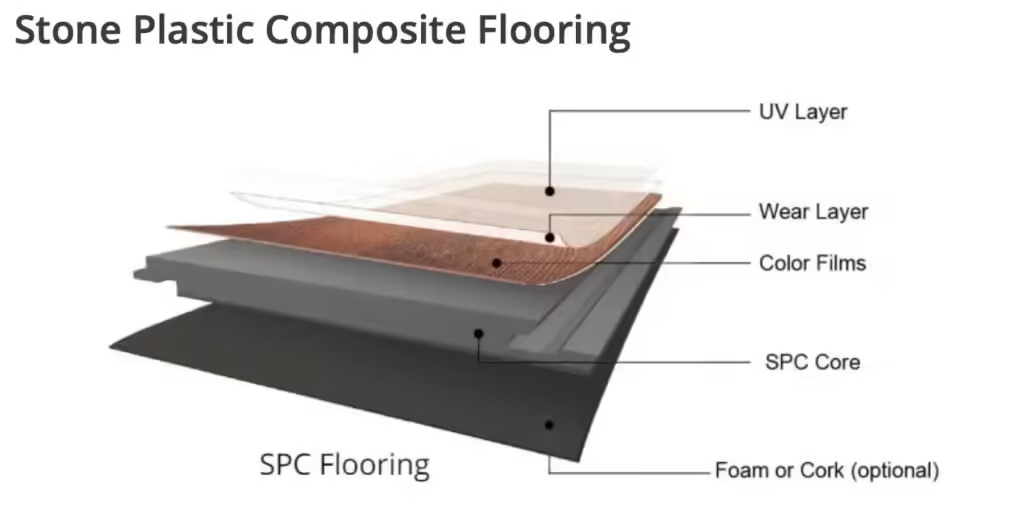
At its core, Rigid Core Flooring uses a stone-plastic composite (SPC) layer composed primarily of limestone powder, polyvinyl chloride, and stabilizers. The high mineral content reduces flexibility and increases density.
According to Designing Buildings Wiki, SPC flooring is classified as a composite material designed for enhanced dimensional performance compared to conventional vinyl systems.
The rigid core acts as a structural backbone
Above it sits:
- A printed decorative film
- A transparent wear layer
- A UV-cured protective coating
Below it may include:
- IXPE or EVA acoustic backing
- Optional underlayment systems
This layered construction explains why the product behaves differently from flexible LVT.
SPC Flooring Over Underfloor Heating: What You Need to Know
The long-tail keyword SPC flooring over underfloor heating is increasing in search demand because heated floors are becoming standard in Europe and parts of North America.
Heat compatibility depends on three variables:
1.Core density
2.Expansion tolerance
3.Maximum surface temperature limit
Most manufacturers recommend that floor surface temperature does not exceed 27°C (80°F). Heating systems should be gradually brought to operating temperature before installation.
Industry guidance suggests pre-conditioning both substrate and heating system for at least 48–72 hours prior to installation. Rapid thermal shock is a primary cause of movement-related failures.
Rigid Core Flooring performs particularly well over hydronic systems because the mineral core distributes heat more evenly than wood-based boards.
However, installers must still respect expansion gaps and perimeter spacing.
Flooring for Temperature Changes: Why Stability Matters
Search behavior around Flooring for temperature changes reflects real-world concerns.
Seasonal expansion in traditional wood floors can exceed several millimeters across a large room. In contrast, mineral composite cores exhibit significantly lower linear expansion coefficients.
According to material science data summarized in various building references, limestone-filled PVC composites have improved dimensional stability compared to timber-based substrates.
This matters in:
- Sun-exposed retail storefronts
- Large open commercial halls
- Properties with fluctuating HVAC control
- Regions with high seasonal contrast
Rigid Core Flooring reduces visible joint stress and minimizes peaking or cupping.
It does not eliminate expansion physics — but it manages it more predictably.
Commercial Grade SPC Flooring: What Defines “Commercial”
The phrase Commercial grade SPC flooring is often used loosely. In specification terms, commercial performance is defined by measurable indicators.
Key benchmarks include:
- Wear layer thickness (0.5mm–0.7mm for heavy traffic)
- Abrasion resistance (EN 660 / ASTM D4060)
- Indentation resistance
- Slip resistance ratings (EN 13893 / DIN 51130)
UK Flooring Direct explains rigid core classifications and performance metrics for high-traffic environments:UK Flooring Direct
True commercial Rigid Core Flooring must demonstrate resistance to:
- Rolling loads
- Point loading from furniture
- Repetitive foot traffic
- Surface abrasion
Documentation should include independent lab testing certificates.
Specifiers should always request technical data sheets rather than relying on marketing claims.
Installation Parameters That Protect Performance
Rigid systems reduce error tolerance — meaning installation precision becomes more important, not less.
Recommended best practices:
- Maintain subfloor flatness within 3mm over 2m
- Respect manufacturer expansion gap guidance
- Avoid direct sunlight exposure during acclimatization
- Use appropriate transition strips in large areas
Expansion gaps typically range from 8–12mm depending on area size and climate.
Failure to allow movement space remains one of the leading causes of installation failure, even with Rigid Core Flooring.
Moisture Resistance and Subfloor Conditions
While SPC cores are water-resistant, subfloor moisture remains critical.
Concrete substrates must be tested using:
- Calcium chloride test (ASTM F1869)
- Relative humidity probe test (ASTM F2170)
Moisture exceeding recommended limits can affect adhesives in hybrid systems or create long-term instability beneath floating floors.
Rigid Core Flooring resists top-down moisture well, making it suitable for kitchens, corridors, and retail spaces.
Wet room installations require manufacturer confirmation and proper perimeter sealing.
Acoustic and Comfort Considerations
Higher density improves stability but may reduce inherent flexibility.
To compensate, many products include pre-attached IXPE underlayment for:
- Impact sound reduction
- Walking comfort
- Thermal insulation support
In multi-family housing or hospitality projects, impact sound reduction ratings should be requested.
Rigid Core Flooring with integrated backing often simplifies installation logistics.
Lifecycle and Maintenance Strategy
Maintenance protocol affects long-term durability.
Recommended guidelines include:
- Use pH-neutral cleaners
- Avoid wax-based finishes
- Install entrance mats in commercial spaces
- Replace damaged planks promptly
Because planks use click-lock systems, partial replacement is generally straightforward.
That modularity is a major advantage in commercial environments.
When Rigid Core Flooring Is the Right Choice
Rigid Core Flooring is best specified where the project demands:
- Stability over underfloor heating
- Performance under temperature fluctuations
- Water resistance
- High-traffic durability
It is not a substitute for poor subfloor preparation. Nor is it immune to installation error.
But when properly selected and installed, it provides a balanced combination of structural rigidity, moisture tolerance, and long-term visual stability.
As heating systems become more common and commercial interiors demand resilient materials, Rigid Core Flooring continues to gain specification preference across global markets.
It represents a practical evolution in composite flooring design — not a trend, but a response to environmental and operational realities.